


What Makes Bamboo Sustainable? A Closer Look at the Facts
Bamboo has earned a reputation as one of the most sustainable materials on the planet. But what exactly makes bamboo sustainable, and does it truly live up to the hype? The short answer is yes, but the longer answer is far more interesting.
In this article, we break down the specific qualities that set bamboo apart from conventional materials like hardwood, cotton, and plastic. If you have ever wondered what is bamboo and why it keeps showing up in eco-friendly products, this is your guide.

What Is Bamboo, Exactly?
Before we get into sustainability, it helps to understand what bamboo actually is. Despite appearances, bamboo is not a tree. It is a type of grass, belonging to the family Poaceae. There are more than 1,400 species of bamboo worldwide, and they range from small ornamental varieties to massive timber species that grow over 30 metres tall.
Bamboo is found naturally across Asia, Africa, and the Americas, though it is most abundant in tropical and subtropical regions. China is the world's largest producer of bamboo, with vast managed forests dedicated to commercial harvesting. To learn more about the plant itself, including the different types and how to grow it, see our complete guide on everything about bamboo.
The Bamboo Growth Rate: Why It Matters
The bamboo growth rate is the single most important factor behind its sustainability. Some bamboo species can grow up to 91 centimetres per day under ideal conditions. Most commercially harvested species reach full maturity in three to five years. Compare that to hardwood trees like oak, which take 40 to 80 years to reach harvestable size, or even fast-growing softwoods like pine, which still need 15 to 25 years.
This rapid growth means that bamboo plantations can produce far more usable material per hectare per year than any conventional tree plantation. A single hectare of bamboo can yield up to 20 tonnes of raw material annually, while a typical tree plantation might produce just 2 to 5 tonnes over the same area and timeframe.
Because bamboo matures so quickly, it can be harvested on short rotation cycles without depleting the stock. Farmers typically harvest around 20 to 25 percent of a bamboo stand each year, leaving the rest to continue growing. The harvested culms are replaced by new shoots within weeks.
Bamboo vs Trees: A Direct Comparison
When it comes to environmental impact, the bamboo vs trees comparison is striking.
Regeneration
When a tree is cut down, it dies. A new tree must be planted in its place, and it will take years or decades to grow. When a bamboo culm is harvested, the extensive root system (rhizome network) remains alive and intact. It sends up new shoots within days, and these shoots grow into full-sized culms within months. There is no need to replant.
Carbon Absorption
Bamboo absorbs carbon dioxide and releases oxygen at a higher rate than most tree species. Studies have shown that bamboo can sequester up to 12 tonnes of CO2 per hectare per year, compared to roughly 6 tonnes for a typical young hardwood forest. Bamboo also releases approximately 35% more oxygen than an equivalent area of trees.

Water Use
Bamboo generally requires less water than many commercial tree species. It is also highly effective at capturing and storing rainwater, thanks to its dense root system. In areas prone to drought, bamboo plantations can actually help maintain soil moisture levels.
Soil Health
Bamboo's extensive rhizome network binds soil particles together, significantly reducing erosion. This makes it particularly valuable on slopes and riverbanks. In contrast, tree plantations, especially monoculture operations, can deplete soil nutrients over time and leave the ground exposed after clear-cutting.
Pesticides and Fertilisers
Bamboo naturally resists most pests and diseases, which means it can be grown without pesticides. Most bamboo plantations use minimal or no chemical fertilisers, relying instead on the natural decomposition of bamboo leaves to return nutrients to the soil. This is a significant advantage over cotton farming, which is one of the most pesticide-intensive crops in the world.
How Bamboo Helps Fight Deforestation
The global toilet paper industry alone consumes approximately 27,000 trees every single day. That adds up to nearly 10 million trees a year, and a significant portion of this comes from old-growth and virgin forests. The demand for wood pulp drives deforestation in critical ecosystems, from Canadian boreal forests to Indonesian rainforests.
Bamboo offers a direct alternative. Because it grows so fast and regenerates after harvest, switching to bamboo-based products can dramatically reduce the pressure on forests. This is exactly why products like bamboo toilet paper are gaining popularity. Every roll made from bamboo is a roll that did not require a tree to be felled.
Learn more about how bamboo becomes toilet paper in our article on the production process of bamboo toilet paper.
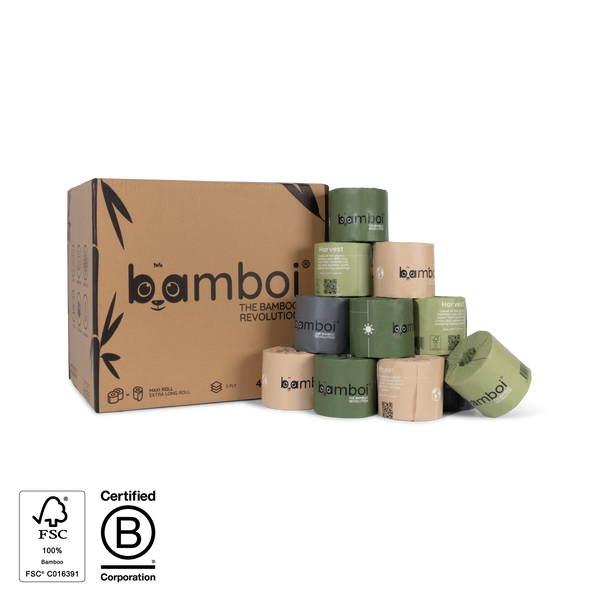
Bamboi
100% Bamboo Toilet Paper
48 MAXI rolls · 3-ply · Plastic-free packaging
€49,99
Order now✓ Free delivery · ✓ FSC certified
Is Bamboo Always Sustainable?
It is worth being honest about the nuances. Not all bamboo products are equally sustainable. The way bamboo is grown, processed, and transported all affect its overall environmental footprint.
Growing Practices
Sustainably managed bamboo forests are genuinely good for the environment. However, if natural forests are cleared to make way for bamboo plantations, the benefits are significantly reduced. Responsible bamboo sourcing means ensuring that plantations are established on appropriate land, often degraded or marginal agricultural areas, rather than by replacing existing forests.
Processing Methods
The way bamboo is processed varies widely depending on the end product. Mechanical processing, which physically breaks down the bamboo fibres, is the most environmentally friendly method. Chemical processing, which uses solvents to dissolve bamboo into a pulp, can involve harsh chemicals if not managed properly. Reputable manufacturers use closed-loop systems that recapture and recycle the chemicals used, minimising environmental impact.
For a detailed look at how bamboo toilet paper is manufactured responsibly, read our guide on how toilet paper is made.
Transportation
Most commercial bamboo is grown in China and Southeast Asia, which means products sold in Europe and North America have a transportation footprint. However, bamboo's lightweight nature and the efficiency of modern container shipping mean that this footprint is relatively small. Multiple lifecycle assessments have concluded that even with transportation accounted for, bamboo products typically have a lower total carbon footprint than their tree-based equivalents.
Bamboo and Biodiversity
Bamboo forests support a wide range of wildlife, including some of the world's most iconic endangered species. Giant pandas depend almost entirely on bamboo for their diet, and bamboo forests in Asia provide habitat for hundreds of bird, mammal, and insect species.
Well-managed bamboo plantations can serve as wildlife corridors connecting fragmented habitats, and they are often compatible with mixed-use farming systems that preserve biodiversity. This is in sharp contrast to monoculture tree plantations, which tend to support far fewer species.
What You Can Do
Choosing bamboo-based products is one of the simplest ways to reduce your environmental impact. Swapping conventional toilet paper for biodegradable bamboo toilet paper is a change that costs very little effort but adds up over time. The average person uses around 100 rolls of toilet paper per year. Multiply that by every member of your household, and the numbers become significant.
If you are looking for a convenient way to make the switch, consider a toilet paper subscription so you never have to think about it again.
The Bottom Line
Bamboo is sustainable because of a combination of factors: its extraordinary growth rate, its ability to regenerate without replanting, its high carbon absorption, its low need for water and chemicals, and its positive impact on soil health. While no material is perfect, bamboo comes closer than almost any other option when it comes to meeting human needs without exhausting the planet's resources.
It is not just hype. It is biology. And it is one of the most practical solutions available to anyone who wants to live a little more lightly on the Earth.




