


Where is toilet paper made?
Where is toilet paper made? Most people never think about it when they grab a new roll. Yet every sheet of toilet paper starts with a raw material, a production process, and a supply chain with surprisingly significant consequences for the environment.
In this article we explain how toilet paper is made, where things go wrong, and how Bamboi® does it differently — from bamboo forest in China to your bathroom.
Where is toilet paper made?
The largest share of the world's toilet paper is produced in China, the United States, and Europe. The raw material is almost always virgin wood pulp: freshly felled wood from forests in Canada, Scandinavia, Brazil, and Russia.
Every day, around 27,000 trees disappear worldwide to be processed into toilet paper. These are not trees that would have been felled anyway — these are forests that are specifically planted or cleared for pulp production, with all the ecological consequences that entails.
How is regular toilet paper made?

The toilet paper production process roughly goes as follows: wood is chipped and cooked into a pulp fiber mass. This mass is chemically bleached to make the paper white, spread onto roll lines, and dried. The creping technique then creates the soft texture we know.
The problem lies in the details. Bleaching is done with chemicals such as chlorine or hydrogen peroxide. Production requires enormous amounts of water — up to 75 liters per roll at some manufacturers. And the end product is almost always packaged in plastic.
Where does Bamboi® make its toilet paper?

Bamboi®, Bamboo toilet paper is produced in the Sichuan region of China, home to one of the largest bamboo forests in the world. The bamboo used is Moso bamboo (Phyllostachys edulis), sourced from FSC-certified forests.
FSC certification means the forest is managed responsibly: no deforestation, no destruction of ecosystems. The bamboo forests in Sichuan are not felled but harvested — and that makes a significant difference.
How does Bamboi® do it differently?

Where conventional toilet paper is bleached with harsh chemicals, Bamboi® uses no bleaching agents. The paper therefore retains its natural light brown color — a deliberate choice, not a design trick.
The production process of Bamb oi® is mechanical and works with steam instead of chemical treatments. The result is a 3-ply, super-soft toilet paper made using the same creping technique as regular paper, but without the chemical intermediate step.
Per roll, Bamboi® uses just 1.75 liters of water, compared to 2.5 to 75 liters at other manufacturers. The MAXI roll contains 40 meters and 370 sheets — almost three regular rolls in one. The packaging consists of plastic-free bamboo paper and boxes made of 100% recycled cardboard.
Why bamboo is a smarter choice
Bamboo is one of the fastest-growing plants on earth. Moso bamboo grows up to one meter per day and is harvestable after just 3 to 5 years. A tree needs 30 to 80 years to reach the same point. Bamboo also grows back from its own root system — the rhizomes — making replanting unnecessary.
Compared to trees, bamboo grows back 30 times faster. At the same time, bamboo forests store 48 tonnes of CO₂ per hectare per year. Bamboo also naturally requires no pesticides: the plant contains Bamboo Kun, an antibacterial substance that makes it resistant to diseases and insects. That further reduces the environmental burden of cultivation.
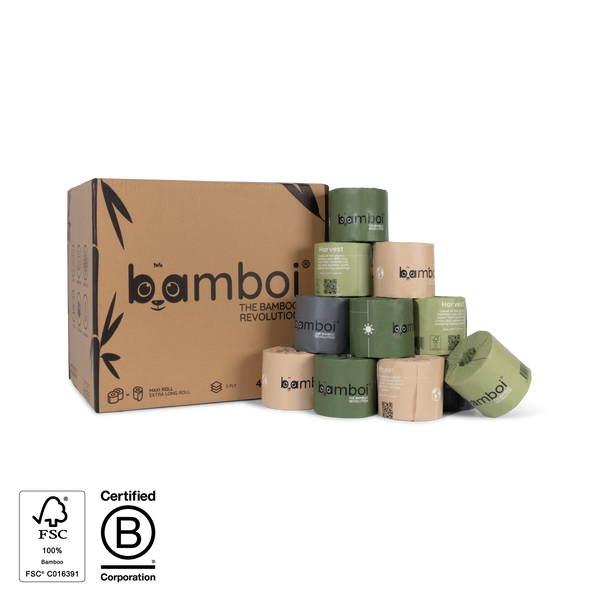
Bamboi
100% Bamboe Toiletpapier
48 MAXI-rollen · 3-laags · Plasticvrij verpakt
€49,99
Order now✓ Gratis bezorging · ✓ FSC-gecertificeerd
Conclusion
Where is toilet paper made? Behind every roll lies a complete production process — with choices about raw materials, chemicals, water, and packaging. Conventional toilet paper costs 27,000 trees every day, along with enormous amounts of water and chemicals. Bamboo toilet paper doesn't solve all of that at once, but it is a meaningful step in the right direction.
Bamboi® deliberately chooses a production process that treats raw materials respectfully and is transparent about what goes into the product. The next time you order a new supply, you now know exactly what lies behind that roll.
Frequently asked questions




