


Who Invented Toilet Paper? The Real History of Toilet Paper
Who invented toilet paper? The answer goes further back than most people think — over fourteen hundred years. And the evolution of toilet paper, it turns out, is far from over.
The Beginning: China in the Sixth Century

The earliest mention of toilet paper dates back to 589 AD. The Chinese scholar Yan Zhitui wrote: "Paper on which quotations or commentaries of the Five Classics are written, I do not use for hygienic purposes." That sentence, seemingly a throwaway remark at first glance, is the first documented evidence that paper was used as a cleaning agent after visiting the toilet.
The fact that China is also the inventor of paper makes the connection logical. Paper was available there relatively early, and its application did not take long to follow.
During the Ming Dynasty, between the fourteenth and seventeenth centuries, toilet paper was produced on a large scale for the first time. The imperial court consumed 720,000 sheets annually, specially manufactured, soft, and in some cases perfumed. The invention of toilet paper was thus already a long-established fact before the West became aware of it.
The Western Invention: America, Nineteenth Century

In Europe and America, other methods continued to be used well into the nineteenth century. It was not until 1857 that the American Joseph Gayetty brought the first commercial toilet paper to market. He called it "Gayetty's Medicated Paper" and had his own name printed on every sheet. It was sold in stacks of 500 sheets.
The perforated roll as we know it today dates back to 1891. On December 22nd of that year, Seth Wheeler patented the toilet paper roll on a holder, including the perforations that made tearing off individual sheets possible. That invention, as simple as it seems, has barely changed since.
The history of toilet paper in the Netherlands runs parallel to the broader Western introduction. Over the course of the twentieth century, the toilet paper roll gradually displaced all traditional alternatives in Europe and became the self-evident hygiene product it still is today.
What Did People Use Before?
Before the invention of toilet paper, the approach depended heavily on class and geography. Wealthy people used cloth, wool, or lace — materials that were reusable and could be washed. At the European court, refined customs prevailed; soft fabrics were a status symbol.
Ordinary people reached for whatever was at hand: leaves, moss, stones, corn cobs, or water. The Romans were remarkably consistent in this regard: they used the tersorium, a sponge on a stick that was rinsed in salt water and shared in public latrines. It was not hygienic by modern standards, but it was the norm for its time.
The Timeline of Toilet Paper
- 589 AD — Yan Zhitui documents the use of toilet paper in China
- 14th–17th century — Ming Dynasty: mass production of 720,000 sheets per year for the imperial court
- 1857 — Joseph Gayetty introduces the first commercial toilet paper in America
- 1891 — Seth Wheeler patents the perforated roll on a holder
- 2020 — Bamboi® is founded in Amsterdam: bamboo as the sustainable next step in the evolution of toilet paper
How Long Has Toilet Paper Existed in the Netherlands and Belgium?
Commercial toilet paper reached the Netherlands and Belgium in the first half of the twentieth century, but only became truly commonplace after the Second World War. During the 1950s and 1960s, the toilet paper roll found its way into an increasing number of Dutch and Belgian households — driven by rising prosperity, improved sanitation, and the rise of supermarkets.
Before that time, the use of newspaper, written paper, or reusable cloth was perfectly normal in the Low Countries. In rural areas and working-class households, this sometimes remained the case for much longer. Toilet paper was initially a luxury product, not a given.
Toilet paper has thus existed in the Netherlands and Belgium as a common everyday product for roughly 70 to 80 years, but as an invention it dates back nearly 1,500 years. That gap says something about how long it took for a Chinese imperial innovation to reach the Belgian and Dutch household.
From Tree to Bamboo: Bamboi® as the Next Step

The invention of toilet paper has made the world more comfortable. But the scale at which it has been produced since then comes at a price. Every day, 27,000 trees worldwide are consumed by conventional toilet paper. The production process requires bleaches, chemicals, and in some cases up to 75 litres of water per roll.
Bamboi® was founded in 2020 by Leroy Ranglek and Joseph Nickisch in Amsterdam with one goal: to prove that it can be done differently. No bleaches, no chemicals, no plastic packaging, and no greenwashing.
The choice for bamboo is not a marketing gimmick — it is a logical next step in the evolution of toilet paper. Bamboo is the fastest-growing plant in the world and can grow up to 91 centimetres per day. Moso bamboo from FSC-certified forests in the Sichuan region of China is harvestable after just 3 to 5 years, while a tree takes 30 to 80 years.
After harvesting, bamboo regrows from its own root system, without replanting and without deforestation. Bamboo forests sequester 48 tonnes of CO₂ per hectare per year. And bamboo naturally contains Bamboo Kun, an antibacterial substance that makes the plant resilient.
Bamboi® processes that bamboo into a 3-ply, ultra-soft toilet paper, using just 1.75 litres of water per roll. The packaging is plastic-free, and delivery is climate-neutral.
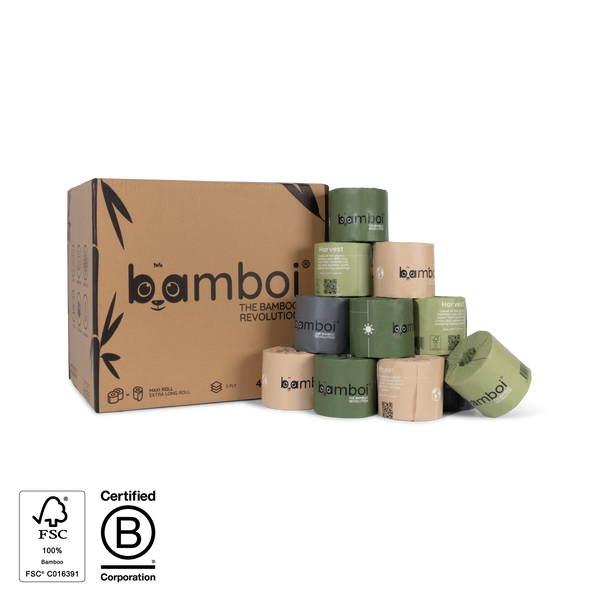
Bamboi
100% Bamboo Toilet Paper
48 MAXI rolls · 3-ply · Plastic-free packaging
€49,99
Order now✓ Free delivery · ✓ FSC-certified
Conclusion
The history of toilet paper began in sixth-century China, was commercialised in nineteenth-century America, and became commonplace in every household during the twentieth century. But the self-evident nature of that small everyday product also has a downside: an enormous strain on forests, water, and raw materials.
Bamboi® proves that the next step in that evolution can already be taken — with bamboo, without compromise. Next time you order a supply, you now know exactly how much history precedes that simple roll.
Explore the range of bamboo toilet paper from Bamboi® and discover how a small choice can make an impact.
Frequently Asked Questions




