


Toilet Paper Facts: The Surprising History and Numbers Behind the Roll
Toilet paper is one of those things most of us never think about until we run out. It sits quietly in our bathrooms, doing its job without fanfare. But this humble household staple has a fascinating history and some genuinely surprising statistics behind it. Here are the toilet paper facts you never knew you needed.

A Brief History of Toilet Paper
Humans have been cleaning up after themselves for thousands of years, but the methods have varied wildly across time and cultures. Before toilet paper existed, people used whatever was available: leaves, grass, corn cobs, seashells, stones, moss, animal fur, and in ancient Rome, a shared sponge on a stick (called a tersorium) that was rinsed in a bucket of salt water between uses.
When Was Toilet Paper Invented?
The earliest known use of paper specifically for bathroom purposes dates back to 6th-century China. By the 14th century, Chinese emperors were ordering sheets of perfumed paper made specifically for the imperial court. The Bureau of Imperial Supplies recorded producing 720,000 sheets of toilet paper per year during the reign of the Hongwu Emperor in 1393.
In the Western world, toilet paper took much longer to catch on. Before commercially produced toilet paper existed, Americans commonly used pages from the Sears Roebuck catalogue or old newspapers. The Farmers' Almanac even came with a hole punched through the corner so it could be hung on a nail in the outhouse.
The First Commercial Toilet Paper
The first commercially packaged toilet paper was introduced in 1857 by Joseph Gayetty in the United States. It was sold as "Gayetty's Medicated Paper" in flat sheets, marketed for its therapeutic properties. Each sheet was watermarked with his name.
Rolled toilet paper, the format we know today, was patented in 1891 by Seth Wheeler of Albany, New York. His patent drawing clearly shows the paper hanging over the roll, not under, which should definitively settle the great "over or under" debate once and for all.
The perforated roll was a significant innovation because it allowed users to tear off individual sheets easily. Before perforations, people had to cut or rip paper from larger sheets, which was messy and impractical.
Toilet Paper by the Numbers
The statistics around toilet paper consumption are staggering. Here are some of the most eye-opening toilet paper facts.
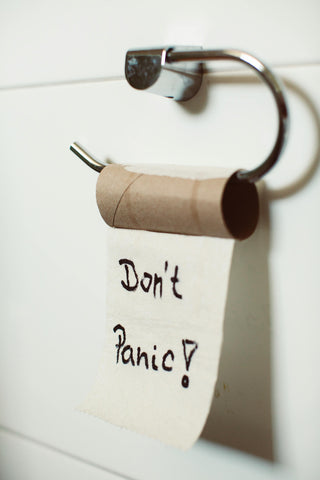
- The average person uses about 100 rolls per year. That works out to roughly 57 sheets per day, or about 20,000 sheets annually.
- Americans use more toilet paper than anyone else. The United States accounts for about 20% of global toilet paper consumption, despite having only 4% of the world's population. The average American uses approximately 140 rolls per year.
- The global toilet paper market is worth over $30 billion. And it is growing year on year as developing countries increase their use of tissue products.
- About 27,000 trees are cut down every day to meet global toilet paper demand. That adds up to nearly 10 million trees per year.
- Producing a single roll of toilet paper requires roughly 37 gallons (140 litres) of water. That figure includes water used to grow the trees, process the pulp, and manufacture the paper.
- The average household spends between $100 and $200 per year on toilet paper, depending on the brand and country.
What Is Toilet Paper Made Of?
Most conventional toilet paper is made from virgin wood pulp. Softwood trees like spruce and pine provide long fibres that give the paper strength, while hardwood trees like birch and eucalyptus provide shorter fibres that make the paper soft. Manufacturers blend these fibres in different ratios to achieve the desired balance of softness and durability.
The production process involves chipping the wood, cooking it in chemicals to break it down into pulp, bleaching the pulp white (usually with chlorine or chlorine-free alternatives), pressing and drying the pulp into thin sheets, and then winding it onto rolls. For a detailed breakdown, check out our article on how toilet paper is made.
Not all toilet paper comes from trees, though. Recycled toilet paper is made from post-consumer waste paper, and bamboo toilet paper is made from fast-growing bamboo grass. Both of these alternatives have a significantly lower environmental impact than virgin wood pulp products.
Weird and Wonderful Toilet Paper Facts
The world of toilet paper is full of oddities. Here are some of the stranger facts we have come across.
- Coloured toilet paper was popular in the 1950s through 1970s. It was available in pink, blue, green, yellow, and lavender to match bathroom decor. It disappeared from shelves in the 1980s after concerns about the environmental impact of the dyes and potential skin irritation.
- There is a toilet paper museum. The virtual Toilet Paper Museum (toiletpaperworld.com) documents the history and cultural significance of TP, including rare vintage packaging and advertising.
- Toilet paper played a role in the space race. NASA developed a special waste management system for astronauts that included specially designed tissue products for use in zero gravity.
- The "over vs under" debate is real. Surveys consistently show that around 70% of people prefer the "over" orientation. The original 1891 patent by Seth Wheeler confirms that "over" is the intended direction.
- Some luxury toilet papers cost over $15 per roll. High-end brands infuse their paper with aloe vera, vitamin E, and even gold flakes.
- Japan has the most advanced toilet culture. Japanese toilets often include built-in bidets, heated seats, and air dryers. Despite this, Japan still consumes about 7 billion rolls of toilet paper per year.
- In 1973, Johnny Carson caused a toilet paper shortage. During a Tonight Show monologue, Carson joked about a toilet paper shortage. The audience took it seriously, and Americans panic-bought toilet paper across the country, causing an actual shortage that lasted weeks. A similar phenomenon occurred in 2020 during the early days of the COVID-19 pandemic.
The Environmental Cost of Toilet Paper
For a product that we use for a few seconds and then flush away, toilet paper has a surprisingly heavy environmental footprint. Beyond the trees cut down and the water consumed during production, there is also the chemical bleaching process, the energy used in manufacturing, and the fuel burned transporting rolls from factory to shop to home.
Conventional toilet paper is also a significant source of water pollution. The bleaching process can release chlorinated compounds into waterways, and recent studies have found that many toilet paper brands contain traces of PFAS (per- and polyfluoroalkyl substances), commonly known as "forever chemicals." You can read more about this issue in our article on PFAS in toilet paper.
The good news is that more sustainable options exist. Biodegradable toilet paper made from bamboo or recycled fibres offers a way to reduce your environmental impact without any sacrifice in comfort or quality.
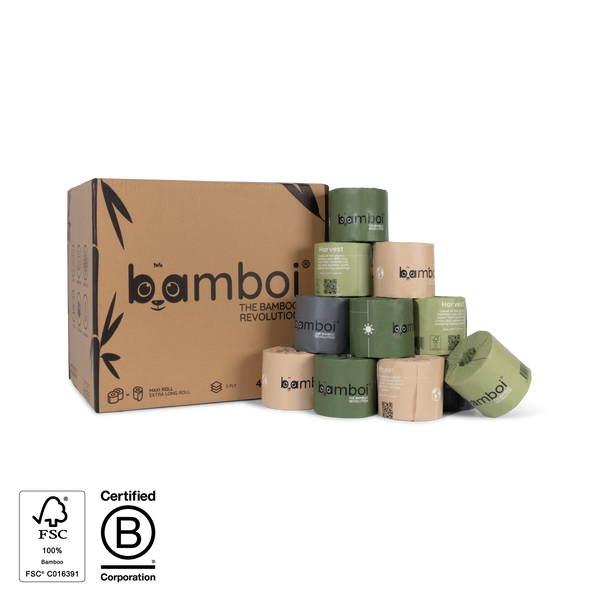
Bamboi
100% Bamboo Toilet Paper
48 MAXI rolls · 3-ply · Plastic-free packaging
€49,99
Order now✓ Free delivery · ✓ FSC certified
How Much Toilet Paper Does the World Use?
Global toilet paper consumption has been steadily rising for decades. As economies develop and living standards improve in countries across Asia, Africa, and South America, more people are using toilet paper for the first time. The global market is projected to continue growing at a rate of 4 to 5 percent per year.
The countries with the highest per-capita consumption are the United States, Germany, the United Kingdom, and Japan. In much of Asia, the Middle East, and parts of Europe, bidets and water-based cleaning are still more common than paper, which significantly reduces per-person consumption in those regions.
The Future of Toilet Paper
The toilet paper industry is slowly shifting in response to environmental concerns and changing consumer preferences. Key trends include:
- Bamboo toilet paper is the fastest-growing segment of the market. Its appeal comes from the fact that bamboo is a rapidly renewable resource that regenerates after harvesting without replanting. Learn about the benefits of bamboo toilet paper to understand why so many people are making the switch.
- Subscription models are becoming increasingly popular, allowing consumers to have toilet paper delivered directly to their door on a regular schedule. This eliminates the need for frequent shop trips and reduces packaging waste. Find out more in our guide to toilet paper subscriptions.
- Plastic-free packaging is now expected by eco-conscious consumers. Many bamboo toilet paper brands, including Bamboi, ship their rolls in recyclable paper or cardboard rather than plastic film.
- Bidet adoption is rising in Western countries, partly driven by the 2020 toilet paper shortage and partly by growing awareness of the hygiene and environmental benefits.
Final Thought
Toilet paper might not be the most glamorous topic, but it touches every person's life, every single day. Knowing where it comes from, how it is made, and the impact it has on the planet puts you in a better position to make informed choices. And sometimes, even small choices, like which toilet paper you buy, can make a surprisingly big difference.




