


The Benefits of Bamboo Toilet Paper: Why More People Are Making the Switch
Bamboo toilet paper has grown from a small niche product into a serious contender in the global tissue market. And it is not hard to see why. When you compare it side by side with conventional toilet paper, the bamboo version comes out ahead on nearly every measure that matters: sustainability, softness, safety, and even plumbing performance.
Here is a detailed look at the benefits of bamboo toilet paper and why it deserves a place in your bathroom.

1. No Trees Are Cut Down
This is the headline benefit, and it is a big one. Conventional toilet paper is made from virgin wood pulp, which means trees, often from old-growth or managed forests, are felled to produce a product we use for a few seconds and flush away. The global toilet paper industry consumes roughly 27,000 trees per day.
Bamboo toilet paper replaces tree-based pulp with bamboo, which is technically a grass, not a tree. When bamboo is harvested, the root system stays intact and produces new shoots within weeks. There is no need to replant, and the grove continues to grow indefinitely. Switching to bamboo toilet paper is one of the most direct ways to reduce your personal contribution to deforestation.
For a full explanation of why bamboo is such a responsible raw material, read our guide on what makes bamboo sustainable.
2. Bamboo Grows Incredibly Fast
Bamboo is the fastest-growing plant on Earth. Some species grow up to 91 centimetres in a single day, and most commercial bamboo reaches full maturity in three to five years. Hardwood trees used for conventional toilet paper take 20 to 80 years to become harvestable.
This growth rate means that bamboo can produce far more usable fibre per hectare per year than any tree plantation. It is a renewable resource in the truest sense: the supply replenishes itself faster than we can use it. Learn more about this remarkable plant in our article on everything about bamboo.
3. Lower Carbon Footprint
Bamboo forests absorb more carbon dioxide per hectare than most tree species. A bamboo plantation can sequester up to 12 tonnes of CO2 per hectare per year and releases approximately 35% more oxygen than an equivalent area of hardwood forest.
Because bamboo regrows from existing root systems, there is no carbon-releasing process of clearing, replanting, and waiting for young trees to reach a stage where they start absorbing significant amounts of CO2. The bamboo grove is continuously growing, continuously absorbing carbon.
When you factor in the full lifecycle, including raw material sourcing, manufacturing, and transportation, bamboo toilet paper typically has a meaningfully lower carbon footprint than conventional alternatives.
4. Naturally Soft
One of the most common concerns people have before trying bamboo toilet paper is whether it will be as soft as the premium brands they are used to. The answer, for most people, is yes, and often softer.
Bamboo fibres are naturally finer and rounder than wood fibres. This gives bamboo toilet paper a smooth, silky texture without the need for chemical softening agents that conventional manufacturers often add. Many people who switch to bamboo toilet paper comment that it feels noticeably gentler on the skin.
5. Hypoallergenic and Gentle on Sensitive Skin
Bamboo toilet paper is an excellent choice for anyone with sensitive skin, allergies, or conditions like eczema. Because bamboo fibres are naturally smooth and the best brands avoid adding fragrances, dyes, chlorine bleach, and other irritants, the result is a hypoallergenic toilet paper that is less likely to cause irritation or allergic reactions.
This is particularly important for young children, elderly people, and anyone with skin conditions that make them more reactive to chemicals in everyday products. If you are concerned about what is in your toilet paper, our article on PFAS and chemicals in toilet paper is worth reading.
6. Naturally Antibacterial
Bamboo contains a natural bio-agent called "bamboo kun" that gives it inherent antibacterial and antifungal properties. While some of this natural resistance is reduced during the pulping process, studies have shown that bamboo-based products retain a degree of antimicrobial activity compared to conventional wood-based products.
This is not a reason to expect bamboo toilet paper to act as a disinfectant, but it is a nice additional property that sets it apart from tree-based alternatives.
7. Better for Your Plumbing
Bamboo toilet paper breaks down faster in water than most conventional toilet papers. This means fewer blockages, less strain on your plumbing system, and fewer calls to the plumber.
This is especially relevant if your home has a septic tank, older pipes, or low-flow toilets. Thick, heavily treated conventional papers can resist dissolving for a surprisingly long time, contributing to clogs and septic system problems. Bamboo toilet paper dissolves quickly and completely, making it one of the most plumbing-friendly options available.
Already dealing with a blockage? Check our guide on how to fix a toilet clogged by toilet paper.
8. Fully Biodegradable
Bamboo toilet paper is fully biodegradable. It breaks down naturally and completely in water and soil without leaving behind harmful residues. This is important not only for plumbing and sewage systems but also for anyone who uses toilet paper while camping, hiking, or travelling.
Conventional toilet papers treated with wet-strength resins, fragrances, and other chemical additives can take much longer to decompose and may leave persistent compounds in the environment.
9. No Pesticides or Fertilisers Needed
Bamboo is one of the few commercial crops that can be grown without pesticides or synthetic fertilisers. It has natural pest resistance and enriches the soil through its own leaf fall, which decomposes and returns nutrients to the ground. This stands in stark contrast to tree plantations, which often require chemical management, and cotton farming, which is among the most pesticide-intensive agricultural activities on the planet.
Choosing bamboo-based products means supporting an agricultural system that is inherently less harmful to ecosystems, waterways, and farm workers.
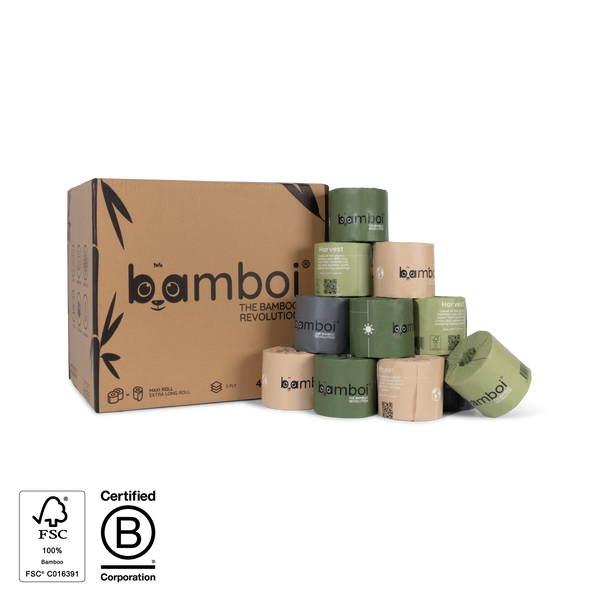
Bamboi
100% Bamboo Toilet Paper
48 MAXI rolls · 3-ply · Plastic-free packaging
€49,99
Order now✓ Free delivery · ✓ FSC certified
10. Reduced Chemical Exposure
Conventional toilet paper production involves a long list of chemicals: chlorine or chlorine dioxide for bleaching, formaldehyde-based wet-strength resins, synthetic fragrances, softening agents, and in some cases, BPA from recycled content. Recent research has also found traces of PFAS (per- and polyfluoroalkyl substances) in many conventional toilet paper brands.
The best bamboo toilet paper brands keep their chemical footprint to a minimum. They use TCF (Totally Chlorine Free) or hydrogen peroxide bleaching, skip the fragrances and dyes, and avoid wet-strength additives. The result is a cleaner product that exposes your skin to fewer synthetic chemicals.
11. Plastic-Free Packaging
Most conventional toilet paper is wrapped in single-use plastic film. Eco-conscious bamboo toilet paper brands package their rolls in paper or recyclable cardboard instead. This means no plastic waste from your toilet paper purchase, which is a simple but meaningful step towards reducing household plastic consumption.
12. Strong and Absorbent
A common misconception is that eco-friendly means lower quality. In the case of bamboo toilet paper, the opposite is often true. Bamboo fibres are naturally strong and absorbent. A well-made bamboo toilet paper performs just as well as, and frequently better than, conventional premium brands in terms of tear resistance, absorbency, and overall feel.
The production process of bamboo toilet paper is designed to maximise these natural properties, resulting in a product that does not ask you to compromise on performance for the sake of the environment.
13. Supports Sustainable Agriculture
By buying bamboo toilet paper, you are helping to create economic demand for sustainably grown bamboo. This supports farming communities in bamboo-producing regions and incentivises the expansion of bamboo cultivation over less sustainable land uses. Bamboo plantations can also be established on degraded or marginal land, helping to restore ecosystems that have been damaged by previous agricultural or industrial activity.
How to Make the Switch
Switching to bamboo toilet paper is one of the easiest eco-friendly changes you can make. There is nothing to learn, no new habits to form, and no sacrifice in comfort or performance. You simply replace what you currently buy with a better option.
The most convenient way to make the switch is through a toilet paper subscription. Set your preferred delivery schedule and have bamboo toilet paper sent directly to your home. No more last-minute trips to the shop, and no more forgetting to stock up.
If you want to try before you commit, Bamboi's sample pack is a great place to start. And if you are ready to go all in, check out the bulk buying options for the best value.
Curious about the full story behind how this product is made? Read our detailed look at how toilet paper is made.




