


The Production Process of Bamboo Toilet Paper: From Stalk to Roll
Bamboo toilet paper has gone from niche curiosity to mainstream option in just a few years. But how exactly does a towering bamboo stalk become the soft roll sitting in your bathroom? The production process is surprisingly involved, and understanding it helps explain why bamboo toilet paper is both a high-quality product and a genuinely better choice for the environment.
Here is a step-by-step look at how bamboo toilet paper is made, from the moment the bamboo is harvested to the finished rolls that arrive at your door.

Step 1: Growing and Harvesting Bamboo
The production process starts in the bamboo forest. Most bamboo used for toilet paper is Moso bamboo (Phyllostachys edulis), a species native to China that grows up to 28 metres tall and reaches full maturity in just three to five years. Compare that to the 20 to 80 years it takes for hardwood trees to become harvestable, and you start to see why bamboo is such an attractive raw material.
Bamboo is harvested by cutting mature culms (stems) at the base. Because bamboo grows from an underground rhizome network, cutting a culm does not kill the plant. The root system stays alive and sends up new shoots within weeks. This means bamboo plantations can be harvested year after year without replanting, making it a truly self-renewing resource.
Responsible bamboo producers follow selective harvesting practices, taking only 20 to 25 percent of the mature culms each year and leaving the rest to support the ongoing health of the grove. No pesticides or fertilisers are typically needed, as bamboo is naturally resistant to pests and enriches the soil through its own leaf drop. For a deeper look at why this matters, read our article on what makes bamboo sustainable.
Step 2: Chipping
After harvest, the bamboo stalks are transported to a processing facility where they are fed into industrial chippers. These machines cut the thick bamboo culms into small, uniform chips, roughly 2 to 3 centimetres in size. Chipping the bamboo increases the surface area of the material, which is essential for the next stage: pulping.
The leaves and outer bark are typically removed before chipping, though the exact preparation varies between manufacturers. Some facilities also split the bamboo lengthwise before chipping to make the process more efficient.
Step 3: Pulping
Pulping is the process of breaking down the bamboo chips into individual cellulose fibres. This is the most critical step in determining the quality and environmental footprint of the finished toilet paper.
There are two main pulping methods:
Mechanical Pulping
Mechanical pulping uses physical force (grinding and pressing) to separate the fibres. It retains more of the original plant material, including lignin, which means the resulting pulp is darker in colour and slightly rougher. Mechanical pulping uses less energy and fewer chemicals, but the paper it produces is generally not as soft.
Chemical Pulping (Kraft Process)
Most bamboo toilet paper is made using a chemical pulping process, typically the Kraft method. The bamboo chips are cooked in a pressurised vessel called a digester, along with a solution of sodium hydroxide and sodium sulphide. This chemical bath dissolves the lignin and hemicellulose that bind the fibres together, leaving behind pure cellulose pulp.
The Kraft process produces a cleaner, softer pulp that results in a higher-quality toilet paper. The trade-off is the use of chemicals, but reputable manufacturers operate closed-loop systems that recover and recycle the cooking chemicals, minimising waste and environmental impact.
The dissolved lignin and other organic matter become a by-product called "black liquor," which is typically burned as a fuel source to power the pulping process itself. This energy recovery significantly reduces the overall carbon footprint of the manufacturing operation.
Step 4: Washing and Screening
After pulping, the raw cellulose slurry goes through several rounds of washing and screening. Washers remove residual chemicals and dissolved organic matter, while screens filter out any oversized fibre bundles, knots, or foreign material.
This cleaning stage is essential for producing a consistent, high-quality pulp. Any impurities left in the pulp at this point would show up as rough spots or discolouration in the finished toilet paper.

Step 5: Bleaching
Raw bamboo pulp has a light brown or tan colour. To produce white toilet paper, the pulp needs to be bleached. The bleaching method has a significant impact on the environmental credentials of the final product.
- Elemental Chlorine Free (ECF) bleaching uses chlorine dioxide instead of elemental chlorine. This is a substantial improvement over traditional chlorine bleaching and is the most common method used in modern paper mills.
- Totally Chlorine Free (TCF) bleaching uses oxygen, ozone, or hydrogen peroxide. This is the most environmentally friendly bleaching option and produces no chlorinated by-products at all.
- Unbleached options skip this step entirely, resulting in a natural brown or cream-coloured paper. Some consumers prefer this as the most natural choice.
The best bamboo toilet paper brands use TCF or hydrogen peroxide bleaching to keep the process as clean as possible.
Step 6: Paper Making
The bleached (or unbleached) pulp is diluted with water to form a very thin slurry, typically around 0.5% fibre and 99.5% water. This dilute mixture is spread evenly across a fast-moving wire mesh belt. As the mesh moves forward, water drains through it, and the cellulose fibres settle into a thin, uniform sheet.
The wet sheet then passes through a series of press rollers that squeeze out additional water and compress the fibres into a denser mat. At this point the sheet is still quite damp and fragile.
Next, the sheet moves onto a large heated drum called a Yankee dryer. This steam-heated steel cylinder, which can be over 5 metres in diameter, rapidly evaporates the remaining moisture. A creping blade scrapes the dried sheet off the drum surface, creating the tiny wrinkles that give toilet paper its softness and slight stretchiness.
For a comparison of how this process differs from conventional toilet paper manufacturing, see our article on how toilet paper is made.
Step 7: Embossing and Ply Bonding
After the paper is formed and dried, it can be embossed with decorative or functional patterns. Embossing presses tiny indentations into the paper surface, which increases its bulk, improves its absorbency, and gives it a more premium feel.
For multi-ply products, two or three layers of paper are bonded together at this stage. The layers are held together by a combination of the embossing pattern itself and a light application of food-grade adhesive. The embossing pattern on each layer is offset so the raised areas on one layer nestle into the indentations on the other, creating a thicker, more cushioned product.
Step 8: Converting
The finished paper is wound onto enormous parent rolls, which can weigh over a tonne each. These parent rolls are then loaded onto converting machines that rewind the paper at the correct tension onto cardboard cores, creating the familiar consumer-sized rolls.
Perforating blades score the paper at regular intervals so sheets can be easily torn off. Log saws then cut the long tubes of wound paper into individual rolls. The speed and precision of modern converting equipment means that thousands of rolls can be produced per hour.
Step 9: Packaging and Distribution
Conventional toilet paper brands typically wrap their rolls in plastic film. Bamboo toilet paper brands that are committed to sustainability use paper wrapping or recyclable cardboard instead, keeping the entire product plastic-free from manufacturing to delivery.
Finished rolls are packed into cases and shipped to warehouses or directly to consumers. Many bamboo toilet paper companies, including Bamboi, sell primarily through direct-to-consumer channels, which can reduce the packaging and handling waste associated with traditional retail distribution.
Why the Production Process Matters
Understanding how bamboo toilet paper is produced helps explain why it costs what it does, and why that cost is justified. The raw material is grown without pesticides, harvested sustainably, processed with care, and packaged without plastic. Every step of the process is designed to minimise environmental impact while producing a product that is genuinely soft, strong, and effective.
Conventional toilet paper production, by contrast, starts with cutting down trees that took decades to grow and relies heavily on chemical processing and plastic packaging. The difference in environmental impact between the two is substantial.
Curious about all the specific advantages? Read our article on the benefits of bamboo toilet paper for the complete picture.
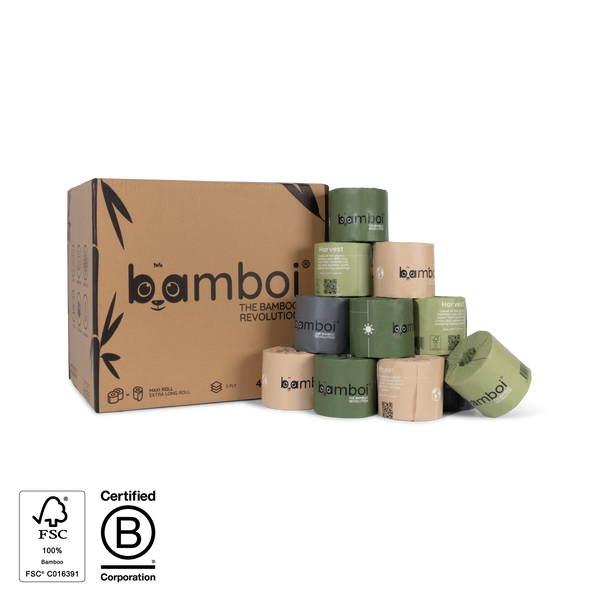
Bamboi
100% Bamboo Toilet Paper
48 MAXI rolls · 3-ply · Plastic-free packaging
€49,99
Order now✓ Free delivery · ✓ FSC certified
Try It for Yourself
The best way to appreciate the quality of bamboo toilet paper is to feel it. If you have not tried it yet, order a sample pack and see the difference that a better production process makes. You might also be interested in learning more about the bamboo plant itself and the remarkable properties that make it such a versatile resource.




